Why the Doorway Sets a Room’s First Impression
A doorway’s position shapes a room’s first impression. Learn to spot abrupt arrivals and adjust the approach with simple, room-aware changes.
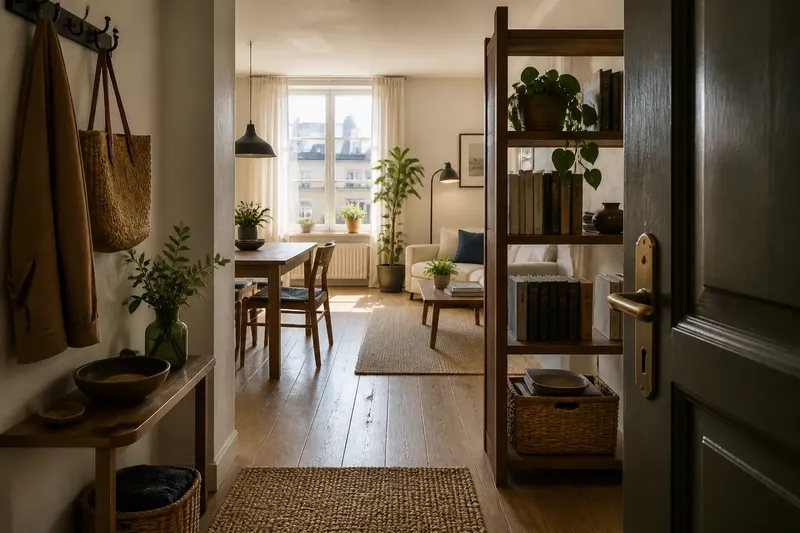
You open the door and meet the back of a chair, a blank wall or a sudden view of the whole room. That first impression is shaped less by decoration than by the doorway: its position, what it reveals and the first few steps beyond it. If entering feels awkward, notice what the entrance asks your body and eyes to do before rearranging the room.
Why does doorway position change the first impression?
A doorway is both an opening in a wall and a point of arrival. From the threshold, you begin to read the room: where you can walk, where people might sit and which parts seem private. A door near a corner offers a different first view from one centred on a wall, even if the room and furnishings are identical.
Visibility matters, but it does not mean that every room should be displayed at once. A direct view can make a compact room feel easy to understand; it can also leave a bed, desk or crowded work surface exposed. An angled entrance may reveal less but give the eye a moment to settle.
Pay attention to the first few steps, not just the view from the hallway. A clear arrival lets you move in without turning sideways, stopping short or guessing which route is open. Those small movements often explain why a room feels welcoming, confusing or abrupt.
Why do I walk straight into furniture?
This usually happens when the entrance and the furniture’s footprint compete for the same patch of floor. A chair pulled back from a table, a coat stand or the corner of a sofa can occupy space that looks free when the room is empty. The obstruction may be obvious only once someone is carrying a bag or holding the door.
Try observing the entrance during ordinary use. Notice whether the door leaf blocks a useful route, whether a person has to pause for someone already inside, and whether the first step lands in a narrow gap. Keep a temporary bag or basket out of the way while you make these observations; it is easier to see the path when the floor is not being used as storage.
If the route is pinched, test a small change before moving several pieces. Pull a lightweight chair farther into the room, shift a floor-standing object to a different wall, or turn a narrow console so its edge no longer catches the approach. The aim is not to make a formal corridor, but to give the arriving person a legible place to step and turn.
Why does the room feel abrupt as soon as I enter?
An abrupt arrival often comes from a hard visual stop: the door opens onto a close wall, a tall cupboard or the back of a large piece of furniture. The room may still be easy to use, yet the first glance gives no hint of where to go next. A sudden change from a dim hall to a bright window can create a similar jolt.
Check what sits directly in the sightline at normal standing height. If a solid object dominates it, see whether an open side of the room can be made visible by shifting a movable piece. A slim bookcase set perpendicular to a wall, for instance, may mark an edge without becoming a barrier; a low bench can provide a landing place while keeping more of the room in view.
Do not add a decorative screen simply to soften the view. A screen can make a narrow entry more cramped and create another object to walk around. What is not worth the effort is arranging a staged display that works only when every chair is pushed in and no one is entering with anything in their hands.
What if the doorway reveals too much?
A doorway can make a room feel exposed when it opens directly onto a bed, a work area or the busiest part of a small flat. The problem is not necessarily that these things are untidy. Rather, the entrance gives no visual pause between the shared route and the part of the room that asks for privacy or concentration.
First decide what should remain visible from the threshold. Then consider whether a movable object can redirect the view without closing the walking route. A bookcase with open shelves, a low storage unit or a curtain on an existing track may soften a direct sightline; the right choice depends on how much light and access the room needs.
Say you enter a narrow bedroom and immediately see the desk covered in papers. If you move a freestanding bookcase beside the desk, with its open side facing the doorway, the desk may become less prominent while the route to the bed remains visible. The expected change is easy to check: from the threshold, the eye meets the shelf first, but a person can still walk around it without squeezing past furniture.
How can I tell whether an entrance feels clear or abrupt?
Walk in at an ordinary pace, pause just inside and note where your attention goes. Then repeat the arrival while carrying something that changes your balance or blocks part of your view, such as a shopping bag. These simple observations can expose a route that seems obvious when the room is empty but awkward in daily use.
- Door swing: Does the open door cover a useful place to stand, sit or pass?
- First step: Is there enough clear floor to enter without sidestepping?
- Eye line: Does the first view offer a useful cue, or stop at a blank or bulky surface?
- Destination: Can you tell where the main route leads without crossing a cramped corner?
- Privacy: Does the entrance expose a part of the room that would be more comfortable screened?
- Shared movement: Can someone inside pass the doorway while another person enters?
Change one movable element at a time, then walk the same route again. This keeps the cause and effect easy to read. If several pieces move at once, you may improve the arrival without knowing which change helped—or make the route harder to use elsewhere.
How should I deal with a doorway that cannot move?
In a rented flat or an older city room, the entrance is rarely a practical thing to alter. You can still influence what it reveals. Keep the area immediately behind the door clear, make the main route readable, and use furniture height and placement to decide which parts of the room meet the eye first.
A mirror can help a dim approach feel less closed, but its reflection should be checked from the actual threshold. It may send the eye straight back to clutter or create a confusing impression of another opening. A coat hook or narrow landing shelf can be useful near the entrance, provided it does not turn the first step into a bottleneck.
If you are considering changes to the door, frame or wall, check the relevant building rules and consult a qualified professional where needed. Most first-impression problems, though, can be investigated with furniture and observation before any alteration is considered.
Which doorway questions come up most often?
Should the entrance show the whole room?
Not necessarily. A view that reveals the main route can feel clear without exposing every activity or private corner. Decide what the room needs to communicate at arrival, then preserve a direct path to its useful areas.
Can a small room still have a welcoming entrance?
Yes, if the first step is usable and the view is not blocked by an avoidable obstacle. In a compact room, a clear patch of floor and one visible destination may matter more than adding a separate entry zone.
Does the door have to be centred on a wall?
No. A doorway near a corner can create a useful approach along the longer side of a room, while a central doorway can make furniture placement harder. Judge it by the route and sightline it creates, not by symmetry alone.
What is the quickest way to assess the arrival?
Stand in the hall, open the door as you normally would and take a few steps inside without stopping to rearrange anything. Notice the first obstacle, the first place you want to look and whether you can turn naturally; those cues point to what deserves attention.
A doorway sets a room’s first impression through a chain of small decisions: what the opening reveals, where the body can move and what catches the eye. When you assess a doorway’s first impression, start with the arrival itself and adjust the room around what you observe. A useful entrance does not need a grand reveal; it needs to make the next step feel obvious without making the rest of the room feel closed off.