Terrazzo: How Stone Chips Shape an Interior Finish
Terrazzo brings visible stone chips into an interior finish. Learn how binders, chip scale and light affect its appearance and how to compare alternatives.
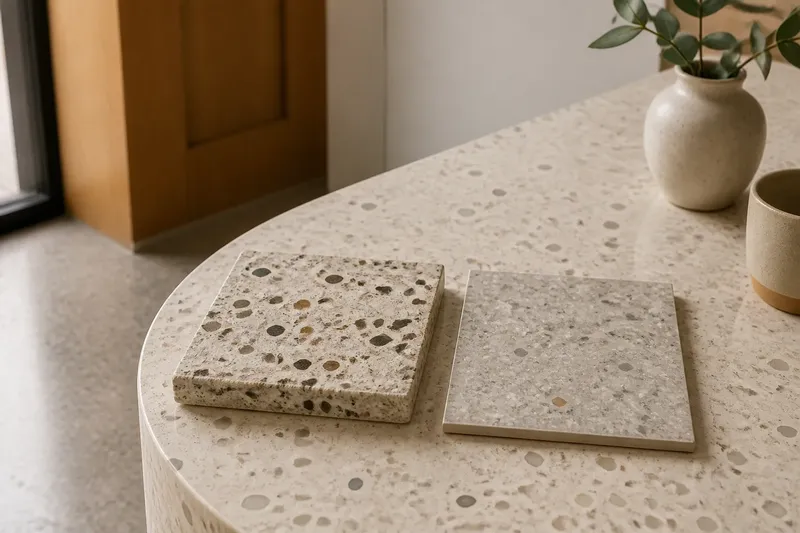
Choosing terrazzo for a hallway floor can hinge on a simple question: will its scattered chips read as calm texture from the doorway, or as a busy pattern underfoot? Terrazzo’s look depends on the aggregate, the binder and the way the finished surface catches light—not just on the word printed on a sample label.
The name covers distinct constructions as well as look-alike products. Knowing what the fragments are and how they are held in place helps you judge whether a surface suits the room’s character and intended use.
How are terrazzo chips exposed?
In traditional terrazzo, pieces of aggregate are set in a binder, then ground and polished so the fragments show at the surface. Marble is familiar, but other mineral aggregates may be used; the visible field combines separate pieces with a continuous matrix.
Chip size and spacing shape the effect. Fine fragments can read as a quiet grain, while larger pieces make the surface more graphic. In a narrow lobby, a broad floor can carry visual interest without a separate motif; in a compact kitchen, a small terrazzo detail can add texture without dominating the room.
Look at the chips’ edges and the gaps between them. A sample viewed close up may seem lively, while the same pattern from a doorway can settle into a more even overall tone.
What is the difference between terrazzo and terrazzo-look surfaces?
Cement-based and resin-based terrazzo use different binders around aggregate. Terrazzo-look porcelain and other printed or composite surfaces can imitate the scattered pattern, but their construction is not the same as a surface made by embedding and exposing fragments in a binder.
A printed porcelain tile may repeat its pattern from piece to piece, and its visible flecks do not necessarily continue through the tile body. A terrazzo sample with exposed aggregate shows actual fragments at its face. Neither choice is automatically better: compare the material description, intended application and care guidance for the product in question.
Say you are choosing a floor for an invented café with an existing pale terrazzo counter. You set a sample of aggregate-and-binder terrazzo and a terrazzo-look porcelain tile beside the counter, then view them under the café’s actual lighting and from the entrance. If the exposed fragments give the counter a convincing material connection, you might favour that sample; if the porcelain’s repeatable pattern coordinates more clearly, you might choose the tile instead.
Check the manufacturer’s product description and care instructions. The name alone may not tell you the binder, construction or suitable uses.
How do colour, light and distance affect the pattern?
Colour relationships influence whether terrazzo feels warm or cool beside other finishes. Warm aggregate in a pale matrix can sit comfortably with timber; cooler fragments may echo a steel fitting or a blue-grey wall. The binder’s contrast with the chips can sharpen their outlines or soften them.
View a sample on the intended plane, not only in your hand. Check it near the floor or wall where it will be installed, then look from the doorway and from close by; the changing distance reveals whether the pattern has the visual weight you want.
Compare samples in the room’s daylight and under its usual lamps. A polished surface may reflect more light and make the chips stand out differently from a less reflective finish. If reflections distract from the room or the fragments become hard to read, consider a less glossy alternative and check the product’s suitability for that location.
What should you check before choosing terrazzo?
- Aggregate: Identify the visible fragments and compare their colours with fixed finishes. If they sit comfortably beside the floor, wall or counter, keep the sample in consideration; if they clash, compare a different aggregate or matrix.
- Chip scale: View the sample close up and from the doorway. If the pattern recedes as intended, retain it; if it feels too busy or too faint, compare a different chip scale.
- Construction: Read whether the product is cement-based terrazzo, resin-based terrazzo, porcelain or another look-alike. If the description matches the material you want, proceed to suitability checks; if it is unclear, ask the supplier for product details before deciding.
- Sheen: Compare the surface in the room’s daylight and usual artificial light. If reflections are comfortable and the chips remain legible, keep it in the running; if glare distracts, consider a less reflective finish.
- Transitions: Set the sample beside adjoining materials and inspect the threshold or joint. If the meeting looks deliberate, retain that combination; if it feels abrupt, compare an alternative edge detail or neighbouring finish.
- Care guidance: Read the maker’s cleaning instructions and compare them with the room’s everyday demands. If the stated care suits the location, continue assessing the product; if it does not, choose an option with guidance better suited to the use.
It is not worth matching every chip to a cushion, lamp or small accessory. The larger relationships—with the floor, walls, joinery and light—usually give a more useful basis for choosing.
Which questions help distinguish terrazzo finishes?
Is terrazzo always made with marble?
No. Marble is a familiar aggregate, but terrazzo may use other mineral chips or combinations of materials. Ask what the visible fragments are made from rather than guessing from the pattern.
Is terrazzo-look porcelain the same as terrazzo?
No. Porcelain can imitate terrazzo’s speckled appearance, but its construction differs from aggregate embedded and exposed in a binder. Compare the product description and sample, not only the visual effect.
Why can terrazzo look different in a sample and a room?
Viewing distance, light and the area covered change how strongly the chips register. Place the sample on the intended plane and view it from more than one position before judging its visual weight.
Can terrazzo be used on walls or counters?
Depending on the product and intended application, terrazzo may appear on walls, counters or smaller interior details as well as floors. Check the maker’s guidance to see whether the particular finish suits that location.
How can you make a choice for a real room?
Imagine you are selecting a finish for an invented, hypothetical entrance beside a timber door and a pale painted wall. You begin with three labelled samples: cement-based terrazzo with fine chips, resin-based terrazzo with larger fragments, and terrazzo-look porcelain. First, you check each product description; the porcelain label confirms a printed look, while the other two identify aggregate held in different binders.
Next, you place the samples on the floor beside the door and wall, then view them from the entrance and close up in daylight and under the usual hall lamp. The fine-chip sample reads quietly from the doorway, the larger fragments draw more attention, and the porcelain’s repeated pattern is the most visually regular. You read each care guide and find that one product’s stated maintenance does not fit the household’s preferred routine, so you remove it from consideration.
The resulting decision is not “terrazzo or no terrazzo” in the abstract. If a quiet, irregular stone surface is the priority, the fine-chip sample remains the stronger candidate; if a regular pattern matters more, the porcelain remains an option, provided its product guidance suits the entrance. This comparison shows how to weigh material construction, room-scale appearance and care without relying on a name alone.
For a terrazzo finish, the useful final check is whether its construction and pattern make sense together in the actual room. A sample beside the fixed finishes, seen at the distance people will approach it, can tell you more than a close-up image on a screen.